


Cause of sticking heater temperature control


Thread Starter
|
Senior Member
Joined: Dec 2005
Posts: 774
From: Canada
 Cause of sticking heater temperature control
I just succesfully replaced the blower motor in our 1992 Accord LX 4AT, no AC, no power anything.
While I had the duct and fan housing removed I discoverd the ulitimate cause of the sticking heater temperature control slider that has caused great trouble and expense to many owners of this generation of Accord.
As I moved the temperature sliding lever back and forth, I could easily see that the foam gasket of the forward-most flapper-door sticks terribly to its plastic seat on the heater-core housing.
I had to pull pretty hard on that front flapper to finally pry it loose from the gasket. Sticky stuff was on the surface of the foam gasket, as well as on the plastic surface where it seated and sealed.
This is the ultimate cause of probably tens of thousands of repeatedly stuck and broken temperature slider controls on these cars.
WhatI believe has happened from Day 1 is that this chemically-improper foam gasket gets sticky from the heat of the heater-core sitting mere inches away. Then, when the car is turned off, this sticky material hardens like a glue between the foam gasket and the plastic.
During the summer, there's not too much trouble, but during cold weather it is almost impossible for the cable to exert enough force to break loose that stuck flapper.
When that cable fails, it's an extemely expensive thing to replace.We had ours replaced shortly after our warranty expired, and the bloody thing broke again within a year. Probably Hoda did not have a clue why this was happening.
I scraped off the sticky stuff on the plastic and removed as much of the sticky surface of the foam gasket as I could. I then considered what to do to keep those surfaces unstuck, so I coated the gasket itself, and the plastic surface it seals against, with a thick layer of silicone grease. Hopefully this will keep those surfaces lubricated enough so that when the gasket softens again it will have nothing to stick to.
If this doesn't work over the long haul, I think the thing to do would be to cut some one-side-sticky paper to the same dimension as the gasket and stick it to the gasket with the not-sticky side facing the sealing surface. That should be the final solution to the problem, and I'm kinda sorry that I thought of it only after getting the thing re-assembled.
While I had the duct and fan housing removed I discoverd the ulitimate cause of the sticking heater temperature control slider that has caused great trouble and expense to many owners of this generation of Accord.
As I moved the temperature sliding lever back and forth, I could easily see that the foam gasket of the forward-most flapper-door sticks terribly to its plastic seat on the heater-core housing.
I had to pull pretty hard on that front flapper to finally pry it loose from the gasket. Sticky stuff was on the surface of the foam gasket, as well as on the plastic surface where it seated and sealed.
This is the ultimate cause of probably tens of thousands of repeatedly stuck and broken temperature slider controls on these cars.
WhatI believe has happened from Day 1 is that this chemically-improper foam gasket gets sticky from the heat of the heater-core sitting mere inches away. Then, when the car is turned off, this sticky material hardens like a glue between the foam gasket and the plastic.
During the summer, there's not too much trouble, but during cold weather it is almost impossible for the cable to exert enough force to break loose that stuck flapper.
When that cable fails, it's an extemely expensive thing to replace.We had ours replaced shortly after our warranty expired, and the bloody thing broke again within a year. Probably Hoda did not have a clue why this was happening.
I scraped off the sticky stuff on the plastic and removed as much of the sticky surface of the foam gasket as I could. I then considered what to do to keep those surfaces unstuck, so I coated the gasket itself, and the plastic surface it seals against, with a thick layer of silicone grease. Hopefully this will keep those surfaces lubricated enough so that when the gasket softens again it will have nothing to stick to.
If this doesn't work over the long haul, I think the thing to do would be to cut some one-side-sticky paper to the same dimension as the gasket and stick it to the gasket with the not-sticky side facing the sealing surface. That should be the final solution to the problem, and I'm kinda sorry that I thought of it only after getting the thing re-assembled.
Last edited by Tony1M; Jan 9, 2015 at 12:46 PM. Reason: corrected spacing of words

Thread Starter
|
Senior Member
Joined: Dec 2005
Posts: 774
From: Canada
RE: Cause of sticking heater temperature control
That intermediate white duct has to be removed to get at the flapper and its gasket. It's not too difficult to remove it, but it's more difficult to re-install it. That bloody metal strip that joins the duct to the fan housing takes some fiddling with to finally getits threaded holes lined up with the correspoinding holes in the plastic duct and fanhousing.
If the silicone grease doesn't fix it for good on our car, I'll take some pictures of the "final solution".
Honda should have discovered this problem, and solved it, in 1992 or 1993. Dealing with that sticky gasket should have gone part and parcel with replacing the slider cable. Not dealing with the gasket almost certainly means that any replacemnet cable will also fail one winter season down the road. Nobody in their right mind is going to give Honda ANOTHER $400 to NOT fix the same problem again.
If the silicone grease doesn't fix it for good on our car, I'll take some pictures of the "final solution".
Honda should have discovered this problem, and solved it, in 1992 or 1993. Dealing with that sticky gasket should have gone part and parcel with replacing the slider cable. Not dealing with the gasket almost certainly means that any replacemnet cable will also fail one winter season down the road. Nobody in their right mind is going to give Honda ANOTHER $400 to NOT fix the same problem again.

Member
Joined: Nov 2006
Posts: 118
From:
RE: Cause of sticking heater temperature control
Are you talking about the slider controls on DX models or the Round dial type like the one below - or both?
[IMG]local://upfiles/6435/3353EA6B301D497C96C72187FC98A194.jpg[/IMG]
[IMG]local://upfiles/6435/3353EA6B301D497C96C72187FC98A194.jpg[/IMG]

Thread Starter
|
Senior Member
Joined: Dec 2005
Posts: 774
From: Canada
RE: Cause of sticking heater temperature control
I'm talking about the slider for heater airtemperature control. It's the bottom slider in this picture:
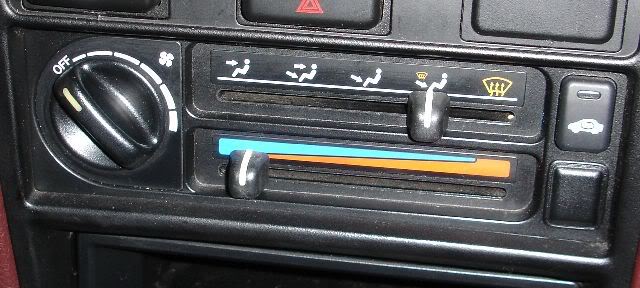
When the slider has been at the hot end (all the way to the right) for a bit of time, it is almost impossible to then move it more thanabout 1/4 of the way to the left -toward cooler air. If you force it, it will break the cable housing, and then you're eitherin for some expensive repair, or you have to unhook the cable where it attaches to the valve/flapper mechaism near the floor under the center of the dash. In the latter case, you're then in "manual" mode and you have to reach under there with your hand and manipulate things to get the temperature you want. My wife and I did that for many years.
When the slider has been at the hot end (all the way to the right) for a bit of time, it is almost impossible to then move it more thanabout 1/4 of the way to the left -toward cooler air. If you force it, it will break the cable housing, and then you're eitherin for some expensive repair, or you have to unhook the cable where it attaches to the valve/flapper mechaism near the floor under the center of the dash. In the latter case, you're then in "manual" mode and you have to reach under there with your hand and manipulate things to get the temperature you want. My wife and I did that for many years.
Unregistered
Posts: n/a
RE: Cause of sticking heater temperature control
I have this same problem with my 91 Accord EX-R, which is the push button mode, with dials for fan speed and temp. I've noticed when the car heats up, the door eventually moves fine. In my car, it sticks in full cold. I guess this door let's air flow over the heater core? I don't think I have a coolant valve - I think hot coolant always flows through the heater core, and the door blends outside air in to control the temperature.
Thread Starter
|
Senior Member
Joined: Dec 2005
Posts: 774
From: Canada
RE: Cause of sticking heater temperature control
Check under the hood near the fire wall - where the two heater-corecoolant hoses penetrate the fire wall. I think you'll see a valve on one of those hoses. Make sure it opens and closes fully when you operate your temperature contol.
Thread Starter
|
Senior Member
Joined: Dec 2005
Posts: 774
From: Canada
RE: Cause of sticking heater temperature control
Just an update because of a new thread about this subject.
Our temperature slider has been working just great this winter. It's very nice to be able to adjust the temperature of in-coming air without having to be a contortionist.
Our temperature slider has been working just great this winter. It's very nice to be able to adjust the temperature of in-coming air without having to be a contortionist.